
Press release2026-11-24
Trust3 AI Joins Databricks, Google Cloud and Salesforce Backing Open Standard for Sharing Context With AI Agents
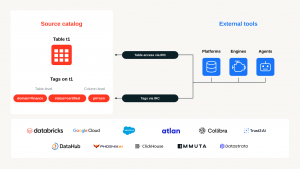
Open catalog labels in Apache Iceberg let Unity Catalog sensitivity tags inform Trust3 AI access policies without a separate metadata sync project.
Classification is only useful if it reaches the place where access is decided.”
— Don Bosco Durai, CTO and Co-Founder, Trust3 AI
SAN FRANCISCO, CA, UNITED STATES, November 24, 2026 /EINPresswire.com/ -- Trust3 AI today announced its support for catalog labels, a new open capability in the Apache Iceberg REST Catalog API, and Databricks Tag Exchange, which exposes Unity Catalog tags through that standard. Together, they let compatible engines, platforms and AI agents read classifications, ownership and business purpose alongside table metadata. For Trust3 AI customers, a column marked sensitive in Unity Catalog can inform a configured masking or access policy.
Trust3 AI stands alongside Databricks, Google Cloud, Salesforce, ClickHouse, Atlan, Collibra, DataHub, PhoenixAI and Datastrato in the effort. See the Databricks announcement.
The Problem: Your Data Moves, Its Meaning Doesn’t
Enterprises now run many engines and AI agents on one open lakehouse. The context that makes data safe to use—who owns it, what it is for, and how sensitive it is has often stayed locked in the source catalog.
Teams rebuild the same classifications on multiple platforms and maintain custom pipelines to sync tags. AI agents can end up working with data that lacks the context needed to interpret it or make access decisions. Every copy of a label is a chance for policy to drift.
What’s New: Catalog Labels and Tag Exchange
Catalog labels add an optional labels field to the Iceberg REST LoadTable response. Catalogs that implement the capability can expose table- and column-level context as key-value pairs, such as domain=customer_support or a sensitivity classification.
The standard defines the exchange format. Each platform interprets the labels and applies its own controls.
Databricks Tag Exchange is in beta and exposes Unity Catalog’s table and column tags through catalog labels. The upcoming PyIceberg 0.13 release is expected to let Python applications and agents read the labels directly.
Discovery with meaning. Search results can show business domain and certification status alongside table names.
Agents that know what they’re touching. An agent can use catalog labels to find the certified customer support table and locate the right column.
Policy that follows the label. A platform such as Trust3 AI can use a sensitivity label as an input to a configured masking or access rule. The receiving platform enforces its configured controls.
Why It Matters for Trust3 AI Customers
Classification helps protect data when it reaches the point where access is decided. Tag Exchange gives Trust3 AI a standard way to read Unity Catalog labels and use them as inputs to access policies for people and AI agents. Data stewards can maintain classifications at the source and security teams can reuse them across supported platforms.
“Classification is only useful if it reaches the place where access is decided. Tag Exchange gets it there,” said Don Bosco Durai, CTO, Trust3 AI.
Trust3 AI joins an ecosystem that spans cloud providers, CRM, analytics engines and data security platforms in making catalog metadata as open and portable as the data it describes.
About Trust3 AI
Trust3 AI provides one control plane for AI agents and data designed to drive responsible, reliable, and secure AI adoption across the enterprise. The platform delivers governed access to enterprise data across OneLake and other data platforms, while providing AI agent discovery, real-time observability, and runtime security helping organizations discover every agent, trace its decisions and actions, and enforce appropriate access controls at scale without compromising compliance. Trust3 AI complements existing enterprise infrastructure, translating trust intent from source platforms into controls that downstream systems understand.
For more information or to request a walkthrough, visit https://trust3.ai/demo/.
Angela Chen
Trust3 AI
angela@trust3.ai
Visit us on social media:
LinkedIn
X
Legal Disclaimer:
EIN Presswire provides this news content "as is" without warranty of any kind. We do not accept any responsibility or liability for the accuracy, content, images, videos, licenses, completeness, legality, or reliability of the information contained in this article. If you have any complaints or copyright issues related to this article, kindly contact the author above.
